> With a new boss, Apple may be showing its strategic interest in deeper integration of AI into its hardware, said Hubbard. "The very strengths that made Apple dominant - their discipline, polish, and control - could become constraints if the next era rewards openness and faster iteration," he said.
The opposite of the basic human interface quality and consistency improvements that several commenters here hope for.
(Admittedly "Hubbard" here is just the first pundit they could grab, an Assistant Professor of Management and Organization, so this isn't the best informed prognostication.)
I honestly think they are just transitioning to a new format for user interfaces. What I mean is I think there’s some hardware coming that is going to make all of the previous user interface is redundant in someway at least in Apple’s thesis and so there’s less focus on making those traditional screens great because we’re gonna have new surfaces.
Critical thought is not about negativity, it is about evaluation. You take a statement and evaluate it based on its merits using an epistemic system which prioritizes consistently, evidence, and logical coherence.
Saying it is disagreeable is like saying that honestly is disagreeable. Sure, it can be, but it is not an inherent feature, and a lot depends on how it is delivered.
This is the ideal: friendly criticism. But first you have to make friends. If your audience aren't your friends, you can exercise your silver tongue to charm them while still delivering your criticism. If they aren't your friends and you unfortunately don't have a silver tongue, you can be negative, or be quiet, or stick to subjects they won't feel defensive about. You can't have the ideal in practical reality.
If you don't have a silver tongue, say what you mean without denigrating anyone or anything, or just don't comment at all. There is no requirement to be negative for the sake of being negative.
That is not an issue, because the tree will have been absorbing freshly made atmospheric carbon-14 until it died, at which point it starts to decay into carbon-12. So carbon-14 dating pinpoints the time of death, if you get the methodology right. We apparently now use accelerator mass spectrometers to just outright count all the atoms of c-14 and c-12. But in the 70s c-14 dating was notoriously tricky and full of pitfalls to with calibration and contamination and estimation, and it looks like we've only reduced the last of those possible sources of errors, the need for estimation, and the rest of it is still sketchy.
But C-14 decay doesn't start with the tree's death, or does it? I assume that a live tree will also contain a certain amount of C-12. What would the result be if we carbon-dated one of the roots of the giant sequoia's in California, versus one of its branch tips?
It's nearly all carbon-12, yes. So you're asking how long it takes a giant sequoia to pump carbon dioxide from its needles [leaves?] to its nethermost reaches. Something like 80 feet. I don't know, but if it takes a year, I'd be surprised and impressed. Further investigation of plant respiration might show that every cell has to exchange gas with the outside on a daily cycle, but I'm not sure.
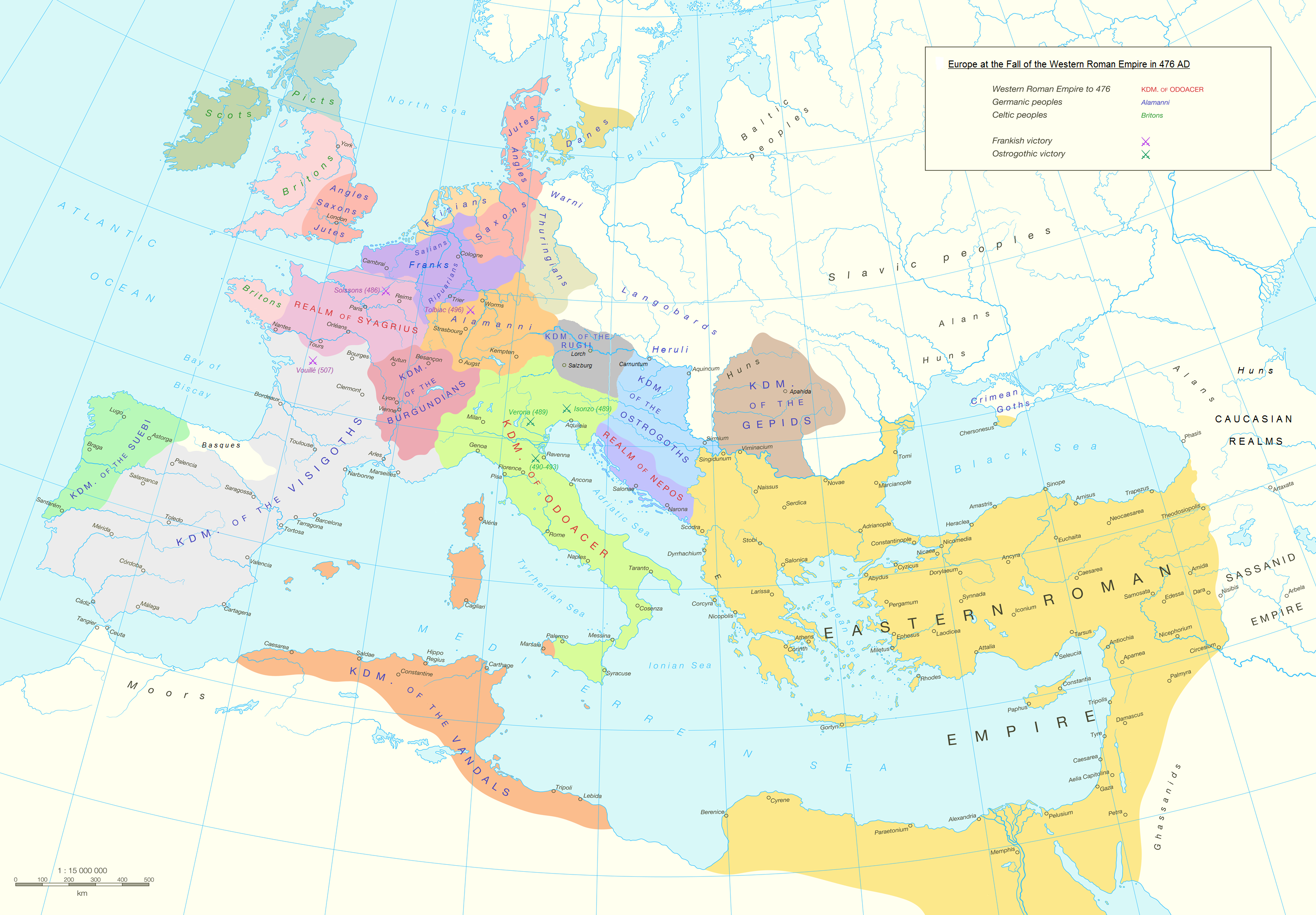
Yeah but again we're coming up against safe archaelogical assumptions based on findings. But when we're talking Saxons and Frisians I find it hard to fail to mention the Angles and the Jutes.
INTPenis is mentioning Angles and Jutes because they were in present day Denmark (and England). You might ask what the cultural difference is, from Vikings, and I'd flounder. Vikings spoke Old Norse, a germanic language related to whatever the other tribes spoke (um, West Germanic, such as Old Frankish). They believed in gods related to the gods of these other tribes and used similar runes.
If you want to say this is an arbitrary modern set of categories ... I guess the Romans are responsible for the categorization really, by writing down tribe names such as Frisii.
Well, it's fair enough to observe that the Vikings spoke a North Germanic language while the Angles, Saxons, Jutes, Franks, and Frisians spoke a West Germanic one. Other than that, it seems pretty clear that the category "Germanic groups such as the Saxons, Franks, and Frisians" would include Vikings. "Such as" isn't exactly the mark of an exhaustive list.
(And interestingly enough, the cognate word ("wicing") is attested in Old English a long time before it's attested in Old Norse. It means "pirate". It wouldn't be at all surprising if Saxons raiding England referred to themselves that way, just like Danes raiding England did later.)
Confusingly, though, there's the chance we might still not be talking about real cognates. The Old Norse víkingr can be derived from (Old Norse) vík (inlet, cove, fjord) + -ingr ('one belonging to', 'one who frequents'), or possibly even something close to Old Norse vika (sea mile), originally referring to the distance between two shifts of rowers, ultimately from the Proto-Germanic ~wîkan 'to recede' and found in the early Nordic verb ~wikan 'to turn', similar to Old Icelandic víkja 'to move, to turn', with well-attested nautical usages.
The Old English wīc, on the other hand, has an old Germanic etymology referring to 'camps', 'villages' and the like.
God knows there are a lot of inlets and fjords in Scandinavia, which incidentally were also places from where the surplus "víkingr" males surged west, possibly having adapted the term as an ethnonym by then; at least in modern Scandinavian languages cognates like 'viking' (pl. 'vikingar') are definitely associated with the geographic root 'vik' — as are innumerable surnames like Sandvik, Vikman, etc. Then again, those roving Vikings did of course build up "camps" and "settlements" wherever they went, although this perhaps sounds more likely a name someone else would give to them...
As for the difference between the Norse (ie North Germanic/Scandinavian) tribes/people and their more southern cousins (Angles, Saxons, Franks etc.) prior to and at the beginning of the Viking era, you might say the former were in fact quite clearly relatively more isolated in terms of geography, language and still-very-much-pagan culture. (And while eg Angles and Saxons did invade and settle much of Britain from current Northern German and parts of Denmark, this was already a couple of hundred years before, and a lot happened since.)
Two thousand years! I thought of the stone ships too (these are burials marked by stones laid out in the shape of a ship), but I went searching for an old example and it seemed like the oldest persuasively dated one is from around 600.
One thing I sometimes hope is true, in my materialistic atheistic way, is to do with the problem of sci-fi teleportation. See, if you go through a transporter on Star Trek, you're taken apart and reassembled. This makes people worry, ludicrously, that the reassembled version "isn't really me". You could after all refrain from taking the original apart, and simply duplicate people. Both copies of some guy called Bernard would claim "I am Bernard", and both would be right.
So this makes me think that from moment to moment, as we pass through time at one second per second, it's as if we're being sent through a transporter. That is to say, if in the far future after my death I am reassembled, or even if just a close imitation of me is assembled from whatever data they can get hold of, then that would be no different from me, or Bernard, being brought back to life. "I am Bernard", he would say, and he'd still be right. Of course other Bernard wouldn't get to share his experiences, but so what. My former self can't share my present experiences.
So, why hope for this to happen at all? It has to be that what we're emotionally invested in is not really "continuity of experience", which is a myth, but continuity of ideas. It's nice if those ideas can sit together in the coherent context of a mind. The Woody Allen quote is "I don't want to achieve immortality through my work; I want to achieve immortality through not dying." But perhaps in fact through your work is good enough, really? Like a close second.
What I mean to say is, I don't so much hope for an afterlife, as to discover that it philosophically doesn't matter anyway. Though I prefer people not dead.
Problems, yes. "Biology is going to kill me soon" shouldn't have to be one of those problems, and in fact I think it makes us all slightly crazy in different ways, from not caring about the future to unscrupulously believing in afterlives.
No, I was disputing "mortality" while agreeing with "challenges", which I've written as problems in the nice sense of "please let me finish my problem". That's some historical figure's alleged last words, I think.
(Edit: probably an embellishment of Archimedes, supposedly saying to the Roman soldier who killed him, "do not disturb my circles!" - not exactly a plaintive attitude about mortality, more just being a grumpy geometrist.)
Have you read any pop neuroscience book? There are common experiences that can be generated by one or another kind of brain-wrong. You sort of acknowledged this already when you mentioned DMT. If you poke somebody in specific parts of the brain you can get illusions of changing size, shadowy figures, mirth, and other delightful errors. We also interpret things very eagerly, like the "night hag" phenomenon where being unable to sense one's own breathing turns into an illusion of something sitting on your chest. That's another worldwide cross-cultural concept, by the way, but there is no night hag, there's just human physiology.
So, bright lights and tunnels. Shared human visual neurological glitches. Heard of "tunnel vision"? That's a real medical condition, which can be caused by blood loss, adrenaline, or low oxygen.
I would be seriously uncomfortable to discover myself making authoritative reference to anything out of a "pop neuroscience" book, unless I had myself validated the claim - at least as far as making sure there is a paper that says what is claimed of it, by whatever failed academic turned mountebank I am reading. (If those guys were comfortable being held to what they say, why did they stop writing for peer reviewers? I'm hardly an academic chauvinist, God knows, but if you want to be safe here in the 2030s, you really need to learn to spot a grifter...)
The tunnel vision you experience during hypovolemia is nothing like the "tunnel of light" reported in NDEs. It's just that you lose your visual field gradually, from periphery to fovea, as your visual cortex loses perfusion. In theory, a well-perfused brain dying for some other reason, such as a sudden complete loss of oxygen supply secondary to circulatory collapse secondary to fine VF or asystole, would retain the ability to "fill in" with something, the way our brains in normal operation cover the many gaps and lacks in our visual perception. (This is part of why I asked the other fellow not to bother me again about this at least until he knows what "ATP" means and why that is relevant here.)
It is strikingly absurd to imagine any of this does or can support a radically materialist conception of the universe. As I said before, materialism is exactly as religious as simulationism - exactly so, inasmuch as I expect to see a "solution" for the "mind-body problem" [1] around the same time as we solve the halting problem or constructively prove P=NP.
OK, you could also read a serious neuroscience textbook, but that seemed a less reasonable thing to expect of anyone. The basic point remains true though.
Tunnel vision is a tunnel, in your vision, associated with death. Since I'm talking to people who will latch on to anything at all similar to a tunnel in reports of experiences, and say "See! Commonalities!", this is sufficient to explain why a lot of the nearly-dead throughout world history have involved something tunnel-like somewhere in their reports.
I don't know who is reporting a "tunnel of light" specifically. I would expect that belongs to a post-1970s culture of near death experiences that's part of the rest of the culture of Forteana and the Mysteries of the Unexplained.
When talking about what evidence supports, really we're talking about the opposite: which theories evidence falsifies, and which surviving, falsifiable theory is the most parsimonious. Falsifiability matters, and parsimony matters. Otherwise, you can imagine what you like, but it carries no weight as an explanation.
Why is that unreasonable to expect? How can someone participate in a discussion of neuroscience without the requisite knowledge?
But, luckily for me, I'm not among those here who have arrogated unto themselves the requirement, with its implicit assumption of the necessary capacity, to explain all or indeed any of this. I'm just here to counsel those who do persist in such insistence, much in the manner of that fellow whose job it used to be to murmur memento mori.
You think it's cute, do you? But there are endless unfalsifiable and silly alternative explanations for everything. They're distinguished only by being silly. The observation that everything could be a simulation deserves a "so what". Maybe you're the cutie pie.
It means something to you that I should be, eh? I don't really take a position in the matter, but one can't spend all day reading - though feel free to continue flattering my looks here while I do so, of course! Being called cute is a rare pleasure indeed for me, these decades.


reply