Exactly. It's like claiming that HTTPS encryption is wasted resources, because all you do is encrypt things at one end, only to decrypt at the other.
Bitcoin's computation does the job of securing the blockchain by forcing an attacker to spend computation cycles to match up the computation done for these hashes.
> Bitcoin's computation does the job of securing the blockchain by forcing an attacker to spend computation cycles to match up the computation done for these hashes.
So we could call this approach to scaling communications, "brute-force messaging"? (..since it also forces anyone who wants to enlarge its available message space to pre-compute hashes ...with an ongoing race condition, so "raced, brute-force messaging"?) Scaling seems a bit off though, since its design enforces "expensive, frantic scarcity". That seems rather limited for a growing population's needs for communications around an increasingly valuable resource base.
> ... anyone who wants to enlarge its available message space ...
Bear in mind that the proof-of-work algorithm actually aims to reduce chatter on the network. Every ten minutes, a single Bitcoin full node broadcasts: "Hey, this is the latest state of the ledger, and you can trust it because [insert proof-of-work that was calculated out-of-band]." So, as the network's processing power scales up, the computation difficulty is also scaled up, so that the "message space" required for consensus remains constant.
> That seems rather limited for a growing population's needs for communications around an increasingly valuable resource base.
While the way distributed consensus is achieved (see "Byzantine Generals' Problem") consumes most of the network's processing power, it's what makes the resource valuable. However, since this is done in parallel, it hardly consumes any of the network's bandwidth, freeing up that "message space" for important things like sending/receiving/propagating transactions, which are much less demanding computationally. All that is required there is some elliptic curve cryptography (ie. a valid public/private key pair + any low-powered device with correct software and an internet connection.)
> HTTPS is the means to an end, bitcoin is just wasting resources.
Bitcoins is also a means to an end, you just don't seem to understand what the end is.
> If the point was just to maintain the blockchain integrity there would be no need to make its difficulty ever increasing.
This is incorrect. The blockchain requires miners to establish an unbiased ledger history. The difficulty parameter is tweaked so that the whole system can be future proofed against an adversary creating a convincing blockchain history (which was biased to double-spending or retracting a transaction).
> This is incorrect. The blockchain requires miners to establish an unbiased ledger history. The difficulty parameter is tweaked so that the whole system can be future proofed against an adversary creating a convincing blockchain history (which was biased to double-spending or retracting a transaction).
What was the excuse in the early days of bitcoin then when the difficulty was orders of magnitude lower?
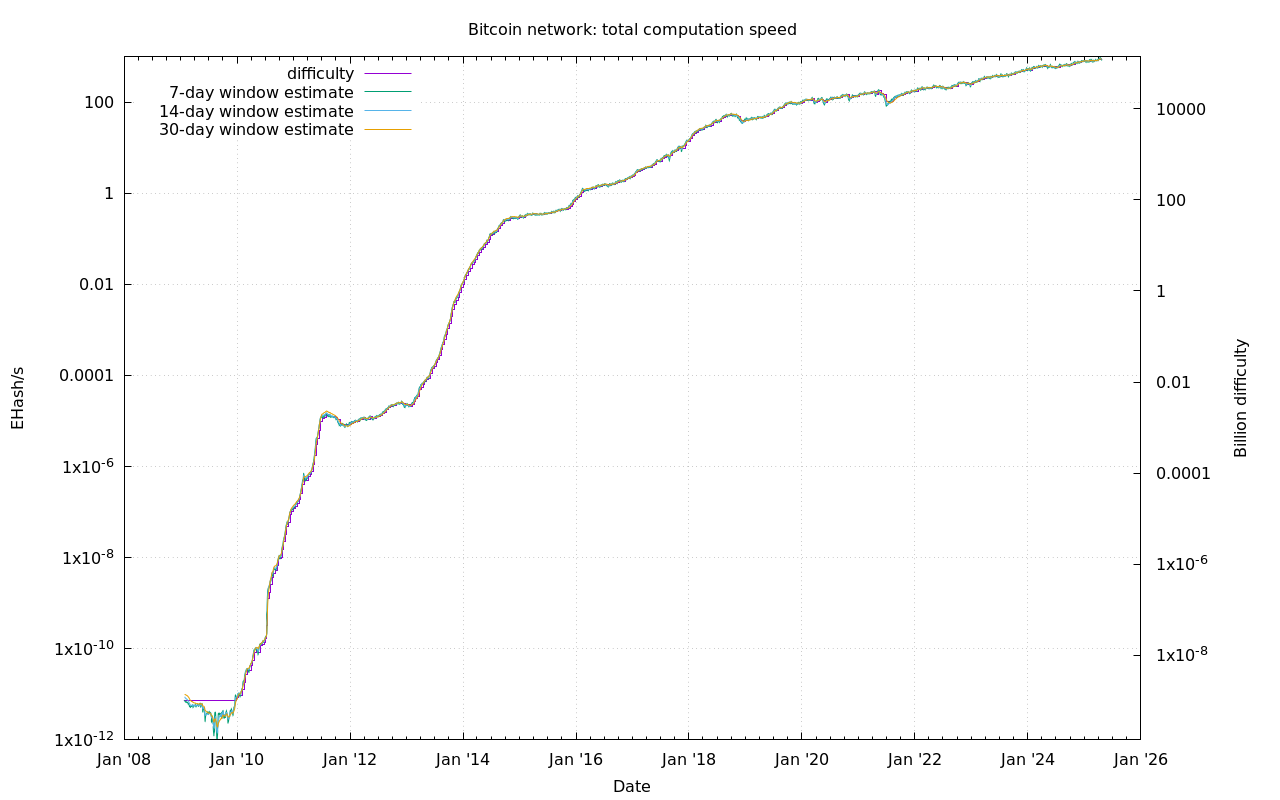
Difficulty is ever increasing just because of the financial model bitcoin tries to propagate. The author of bitcoin wanted to make it deflational and so it had to be this way.
That part has nothing to do with the integrity of the blockchain and you are mixing two concepts here: Blockchain, which was a great invention and bitcoin, a financial experience (nothing against experiences from my part) which turned out to be a waste of resources.
> > This is incorrect. The blockchain requires miners to establish an unbiased ledger history. The difficulty parameter is tweaked so that the whole system can be future proofed against an adversary creating a convincing blockchain history (which was biased to double-spending or retracting a transaction).
> What was the excuse in the early days of bitcoin then when the difficulty was orders of magnitude lower?
... because there wasn't as much hashing power in the bitcoin network? Isn't that obvious? The difficulty parameters are tweaked so that the proof of work takes 10 minutes for the whole network. As the network gets bigger, you need to make it harder to maintain a 10 minute proof of work.
> Difficulty is ever increasing just because of the financial model bitcoin tries to propagate. The author of bitcoin wanted to make it deflational and so it had to be this way.
Eh. You're full of shit. But that's your prerogative.
> That part has nothing to do with the integrity of the blockchain and you are mixing two concepts here: Blockchain, which was a great invention and bitcoin, a financial experience (nothing against experiences from my part) which turned out to be a waste of resources.
Integrity of the blockchain is maintained by cryptographic hashes. There are other security properties (such as proof of work and thus non-malleability) that are maintained by the difficulty parameter.
The difficulty does not NEED to be ever increasing. In fact there are periods of time where the difficulty is pretty stable, such as mid-2011 to early 2013, or the first half of 2015: http://bitcoin.sipa.be/speed-ever.png
> bitcoin is just wasting resources. If the point was just to maintain the blockchain integrity there would be no need to make its difficulty ever increasing. <
Higher difficulty don't waste any more resources than lower difficulty.


Bitcoin's computation does the job of securing the blockchain by forcing an attacker to spend computation cycles to match up the computation done for these hashes.