Facebook acknowledges that it is impossible to police their system because it is so large.
Ergo, the supposed intention is probably manifestly meaningless.
For example, you can point to the use of Facebook as a tool of genocide in Myanmar. Facebook will not, and probably cannot do anything about that beyond removing their service.
You clearly never read much about Parler before any of this happened. The founders are most certainly not rioters. They're libertarians who wanted to found a pro-free-speech Twitter.
Just because you disagree with someone doesn't mean they are bad, evil, or wrong.
But, Parler was not pro-free-speech. It was pro right wing speech of any kind, but if your posts were leftists, they would be deleted and accounts banned.
> Parler's entire point was being an alt-right platform
I don’t think this is a fair statement. From past interviews, it’s clear that the CEO of Parler and its founding team intended for it to be politically neutral and a destination for those of all ideologies. They may have attracted those on the political right, but that’s because Twitter is by default a bastion for the political left and naturally those seeking alternatives would have a different lean. But I don’t think that’s the same as the entire point being an alt-right platform.
The person who scraped the site pointed out that users started out shadow-banned, and were only unmuted after it was confirmed their posts fit a certain profile. That’s definitely not neutral.
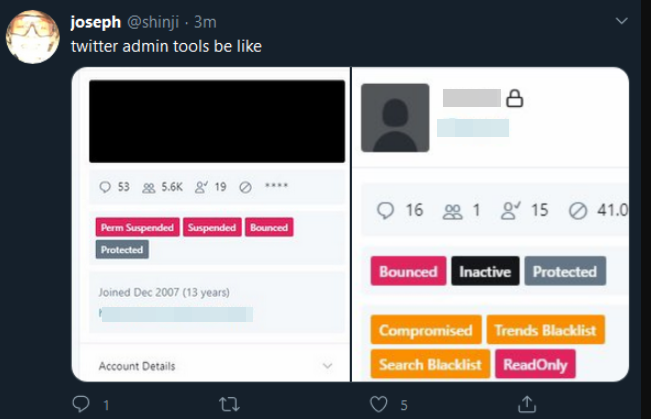
All your reference shows is all politically-neutral anti-SPAM categories[1]. Compare this with Twitter’s internal moderation tool[2] and their granular suppression capabilities which appear deliberately prone to abuse.
I don’t think this particular conjecture is that sensational and backs up what Amazon has already claimed. This list of moderators overwhelmingly are Republicans/conservatives and some of them make concerning assertions in their bios.
I said it’s conjecture and you don’t disagree. I’ll leave it to you how sensational it is. I have biases but I would have no problem in moderating without them as above else I believe in free speech, so this argument is not very convincing, personally. You might be right, though, I’ve never used Parler, so IDK. But evidence is evidence and that Twitter statement was dishonest.
Every medium wants to reach as many people as possible. So they limit the visibility of what they don't like, but they don't completely get rid of people they don't like since they would no longer reach those groups.
Open basically any media and you'll see three categories:
(1) Opinion pieces.
(2) Attempts at appearing neutral by allowing opposing views, but always together with a commentary provided either by themselves or someone else to clearly provide objections.
(3) Safe easily sharable info. Like cute / funny pictures you can send to your friends which will get people into the site.
Fair enough. But is there any evidence to this? From my point of view, Twitter allows people like Steven Crowder, JK Rowling and Radical Feminists to use their platform to spread hate towards trans people, yet if I go there now and make a post with the word TERF in it I'll be suspended immediately.
Why is that a platform considered biased towards left thinking? Because it put warnings under probably false claims by far right presidents? The fact that it's only happened to Trump and Bolsonaro says more about right wing politics than about Twitter itself.
What Parler was, was bad for business. It's not a good look for AWS to be hosting websites with violent content linked to the Capitol insurrection, and apparently doing nothing about it. So they pulled the plug.
The elephant in the room is Facebook. There's lots of evidence they were the most directly responsible [1]. Parler wasn't bad for business but scapegoating it was good PR.
Facebook quite possibly was more responsible because they're more popular. But they also appear to be a actively fighting the misinformation that these groups spread and thrive on.
Whereas Parler is the opposite: they practically celebrate how little they care about undermining democracy with misinformation.
Actually FB let it fester and didn’t do anything about it until recently. Sure, Parler exists to provide this needed freedom of expression to extremists and does not represent what it is but in terms of impact, FB has had a lot more and did nothing about it
Only bad for business because of political dealings. The AWS name was not associated with Parler.
In my view, the more likely actual reason for the cancelling of Parler, as well as for their seemingly excessive hardware requirements, is that Parler wants a shot at competing with Twitter for real, and has convinced their investors that is possible. The latest chaos must be one of the best free marketing anybody in their line of business could hope for.
If realDonaldTrump moves to Parler, and some popular republicans already have, that would potentially bring in a floodwave of new users, and risking that kind of business opportunity by having underpowered servers would be professional malpractice.
Parler is also likely to face months-long DDOS attacks.
The AWS name wasn't associated with Parler and the Capitol insurrection, but it likely would have been. This is all about getting ahead of the story and limiting any potential brand damage.
It's similar to when Cloudflare booted 8chan, after the latter was linked to the white nationalist terrorist attacks in Christchurch and El Paso.
I don't understand the rationale for your view. Why would slapping down a potential Twitter competitor be any concern of AWS?
Their stated aim was to forcibly overturn the results of a free and fair election, so that their leader, who lost, could remain in power.
In what universe is that not an insurrection?
It's not like they just protested outside and maybe broke a few windows with rocks or something. They actually broke through the police defense, broke into the building, and went looking for legislators, who had to be evacuated.
I'm sure one or two idiots out of thousands of people had (or at least expressed) bad intentions. What we're talking about here is the goals of the group.
What other intention did they have in pushing up the steps of the capitol and then inside? It’s not like two idiots did that. They were all attending a “Stop the Steal” rally and were told that their country was being stolen from them. They were told Pence must comply.
Their goal was to stop the counting of the electoral college votes and cause havoc. They were trying to literally subvert the federal government and our collective voting system.
> What other intention did they have in pushing up the steps of the capitol and then inside?
They very obviously didn't have a plan and were just seeing how far they could get. You are imputing too much direction and intelligence to these people.
> They were trying to literally subvert the federal government and our collective voting system.
The capitol doesn't work like a round of Capture the Flag in Halo; just standing there for a few minutes doesn't give you political power. Even the protestors were smart enough to comprehend this.
So you're supposing they were just trying to see how far they could get into the Capitol for what purpose? Fun? Lore? A game?
Nobody else is contending that the Capital is a "round" of capture the flag. You just brought that up for some bizarre reason. The timing of this directly lines up with when they were working to count the electoral college votes. More than a few people were violent toward the cops, and nobody has any reason to believe that they wouldn't have killed some Democratic congresspeople or Pence if they had been able to find them. At least one person did kill a cop and a dozen other cops were injured.
> There's zero evidence that they intended to do anything to legislators.
You mean other than:
(1) Many of them stating their imminent or thwarted intent to do so, either by chants, in interviews, in electronic messages, or otherwise;
(2) Them bringing weapons and restraints with which to do things to legislators;
(3) Them becoming increasingly agitated and violent at the prospects of targets of violence escaping, as occurred when people were evacuated from the Speakers Lobby shortly before the breakthrough where Ashli Babbitt was shot.
> This is the only actual violence that happened and it was an overreaction by the police.
Not true. The mob physically attacked the Capitol police, repeatedly, with a variety of weapons. One of the policemen, who was struck in the head by a rioter wielding a fire extinguisher, later died from his injuries.
> The mob physically attacked the Capitol police, repeatedly, with a variety of weapons.
Can you be more specific than "a variety of weapons"? Almost all interactions with the police seemed peaceful, bordering on friendly, barring the one who was hit on the head.
What is the free speech alternative to Cloudflare for DDOS protection? Activist hackers are everywhere today and have no qualms attacking Parler or others they disagree with. Culturally, many in the younger generation of hackers are anti free speech, or at least against it for their political adversaries. Twitter still hasn’t banned the one archiving locations of Parler users from EXIF data in photos. And with utilities like AWS deplatforming paying customers now, I imagine Cloudflare can’t be relied on either.
I’m not an expert but my understanding is that defending against DDOS requires immense infrastructure. Can a single site in its own achieve that with a load balancer or the rate limiting you mention?
Depends on the scope and scale of the attack. If you put a proxy server in front of the actual application server (or a series of proxy servers that were lightweight/cheap to run), technically speaking you could control it. Not an expert either but have relied on mechanisms like that in the past to help with traffic control.
We already use terms like "denial of service attack", so it's not stretching the English language too much to say that a hosting company shutting down a website is the "digital (equivalent of) violence".
Whether silencing millions of people or ruining a company counts as digital violence against someone is more subjective.
Admittedly it may be more accurate in this case to say "temporarily inconveniencing millions of people", but it must feel quite oppressive to find that the only sub-reddit you use has been blocked, then the only YouTube channel you comment on gets banned, then the only social media app you use gets shut down.
Eventually some of the people affected would just give up on trying to communicate with like-minded people online altogether, which I suppose is the point. Remember, though, we are talking about First Amendment protected speech for most of these people.
You may say that no one needs to be able to communicate online, and as long as someone can use the postal service then they haven't been silenced, but by that logic you could say that a regime which locks up its political opponents hasn't really "silenced" them as long as they are still allowed to write letters.
I was listening to a talk by a former head of the ACLU yesterday (on the JRE podcast). His central point was that all speech (including hate speech) should be free because someone else is going to be deciding what speech shouldn't be free, and therefore nobody should get to decide that.
This fellow seemed to not realise he was living in a democracy and had been doing so his whole life.
He provided some examples to prove his points, and they were all from ages ago. He didn't seem to realise that the trouble we're going through now is a direct result of allowing hate-filled people to form bubbles within which their hate festered until it boiled over.
Without Parler (or any other safe space for these bigots and racists), they benefit from a broader range of views, and that's a better thing for society as a whole.
Conservatives seem to just not get democracy, and as a result see the Government as something distinct from themselves. In my country, the government is folk I (or my neighbours elected), and they enact policy I (or my neighbours) want. We can just as well change that policy in a few years time if we didn't want to. That's democracy 101.
If you live in a democracy, you don't fear your government, and you can trust them to regulate speech, because they'll do what you (or the majority of your peers) want... if not immediately, then in four years time at most.
> This fellow seemed to not realise he was living in a democracy and had been doing so his whole life.
Just because a law is passed in a democracy, doesn't mean it is moral. A law that requires all members of an ethnic or political minority to be arrested should be resisted no matter how "democratic" it is. (I'm not saying a voluntary boycott of Parler is equivalent to that, just that "living in a democracy" isn't, by itself, a complete justification).
> the trouble we're going through now is a direct result of allowing hate-filled people to form bubbles
If the problem is online bubbles forming, then maybe you should be objecting to Parler blocking criticism of right-wing views on its platform (in other words, suppression of speech is the cause of the problem, not the solution). However, to be against Parler banning left-wing hate-filled accounts but not Twitter banning right-wing hate-filled accounts raises the original concern that the person deciding which speech to ban might have political biases.
> Conservatives seem to just not get democracy, and as a result see the Government as something distinct from themselves.
To be fair, in many countries (particularly the US) the electoral system (not to mention lobbying) causes quite deliberate divergence between what the majority of the people want and what the majority of politicians want. Also, to steelman the view which you assign to "Conservatives", it's worth considering that societies should care not just about democracy but about liberty as well, since "we can pass this law" doesn't always mean "we should pass this law".
> If you live in a democracy, you don't fear your government
What a wonderful world that would be. As explained, not every democracy is as representative as you might hope, and not every person even in a perfectly representative democracy can feel safe from their government.
> if not immediately, then in four years time at most.
The Nazi party actually lost seats in the November 1932 German federal election, which was considered free and fair, but just two months later the party had seized power. Also, if we're making international comparisons, UK general elections only occur every five years.
Finally, to give a recent example of how "silence" is used in political discourse, let me give this example:
> High-profile barrister says 10th arrest warrant for Duterte critic showed the Philippines was trying to silence Ressa