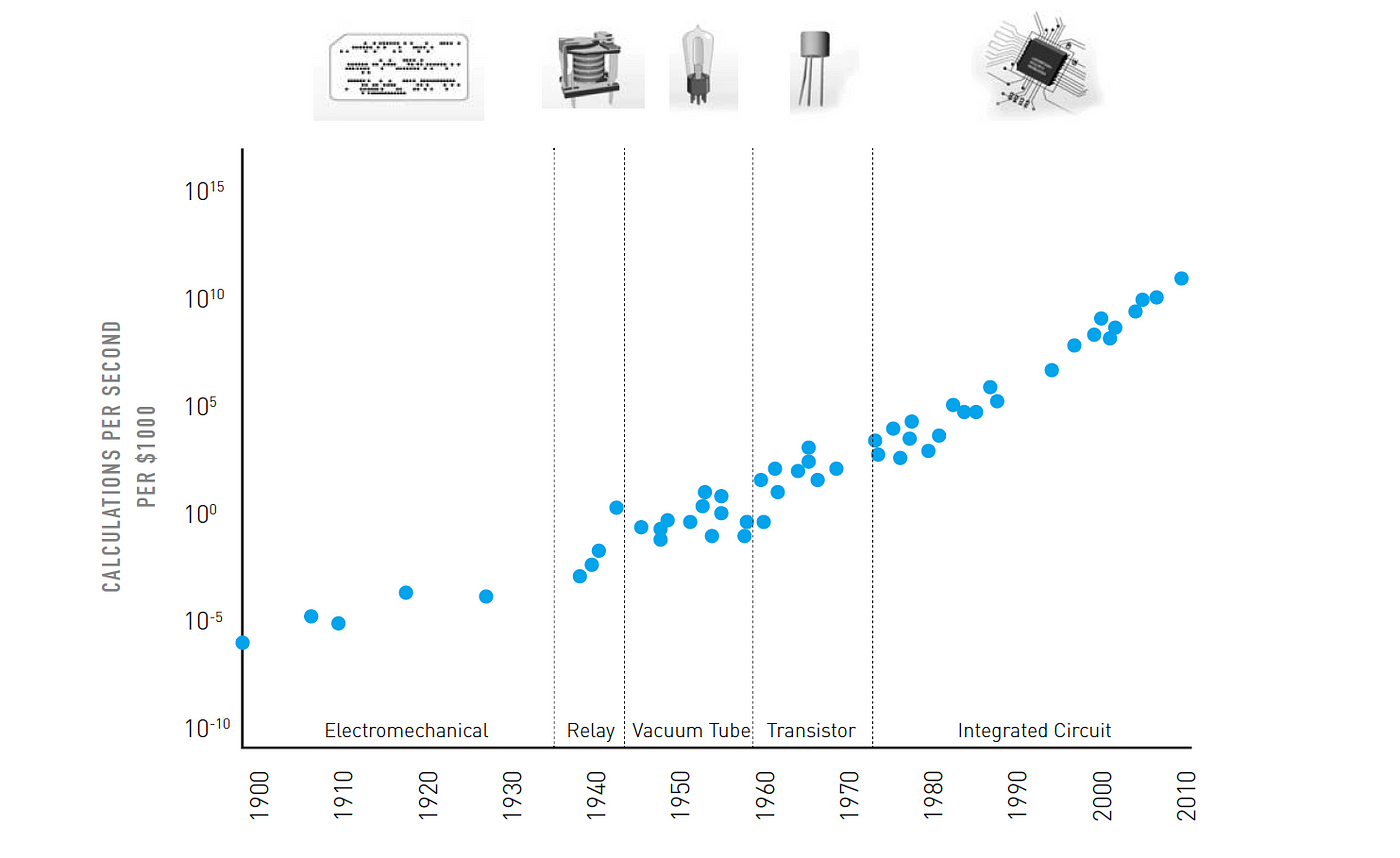
Naw, this is from a quarter century after Moore’s predictions, and Moore’s law had already started slowing down by then. Kurzweil was also selling snake oil (immortality) here, and the proof is in the final figure in the article, it’s 100% misleading and has left me with mistrust for all the rest of what Kurzweil said. Why did he leave out all the population data between 1920 and 2000, data which we have available at our fingertips? Because then he couldn’t have drawn a completely fabricated plot showing continuous lifespan acceleration, acceleration that doesn’t exist. Why does he conflate life expectancy with longevity to imply to the reader that genetics are improving as opposed to, say, the truth about poverty, wars, sanitation, and medicine? Because then it wouldn’t tell an amazing sounding (but completely untrue) story about humans being able to live longer and see the “singularity”. This article proved to me that Kurzweil is a charlatan, which is disappointing because I loved his keynote at Siggraph right around this time where he was pitching these ideas.
Really? I thought the exponential growth of calculations per second per dollar was rather well-established at least from 1900 through 2010 [1], a period of time that is much broader than Moore's Law?
Yes really, there is no law of accelerating returns as far as I’m concerned. Kurzweil clearly tried to opportunistically generalize Moore’s law and take credit for what he thought was a bigger idea, but sadly doesn’t produce a compelling argument, given that 1) Moore’s law died a decade ago, it no longer holds, and cost of calculations per second is no longer decreasing exponentially, and 2) Kurzweil claimed that things like US GDP and human life expectancy are evidence of his so-called law, and these claims are clearly bullshit. And not just wrong but intentionally misleading, that’s the part that bothers me. Did you look at the final figure? It’s not possible to make that diagram or write the accompanying text without knowing you’re lying. How about the first or second ones, wtf even are they? The majority of plots in Kurzweil’s piece, some 20-odd figures, are direct byproducts of Moore’s law from after Moore observed/predicted it, and nothing more.
In case you missed it, my point is not that flops didn’t increased exponentially for most of the last century, it’s that Kurzweil wasn’t the first to observe it, and didn’t add anything rigorous to what Moore & others had already done. Kurzweil only made a mockery of it by fabricating some of the data and using the larger argument to claim we’re headed toward immortality, joining an illustrious list of people who get attention by hawking the fountain of youth.
BTW feel free to re-read Kurzweil’s predictions about computation growth in the article and ask yourself whether they’re true. One of his scheduled predictions is up this year. He’s off by a few orders of magnitude according to his own definitions, and furthermore his definitions are off by a few more orders of magnitude according to other researchers, and on top of that his claim that enough flops equal human brain capability are, to date, false. These things put the remainder of his predictions really far behind schedule, and possibly slipping at an exponential rate, which kinda undermines the whole point, right?