I'm guessing it's about the general rule of thumb that hw is faster than sw, and so can react to urgent situations in a timely fashion. As for why sw might be shorthand for consciousness: sw can modify itself (and thus react to strategic issues)
... so yeah, hw is more or less defined as something that cannot modify itself.
We're altricial, not precocial, so over our lifetimes we can (and hopefully do) alter many of our own "reflex" behaviours. In particular, details of the 4 F's are firmware configurable.
Also, there's lots of potential for failure (and I'd say it is overwhelmingly observable that we have and do) in "can (and hopefully do)". Who knows what our absolute capabilities are, especially if we hardly or maybe even never try (at least certain things)?
Writing the capabilities to firmware is a step after this, but only after the first step is accomplished.
Glad we moved the discussion into the Overton window of firmware.
Maybe it's too early to start shipping metaphors in wetware, but developing general heuristics for productive+reproducible+survivable self-fuzzing? (*)
"n X's" might still be a useful template to keep in mind, yes?
Here are some good resources to explore the pain-gain frontier. (Or its baby versions, the supplies-surprise dilemma, shiprate quantification, etc.)
[0] caveat lector: "nature physics" is where economics that's almost certain to be rejected for very good proboscidean-tail-wiggling reasons would be dumped.
(*) Going back to the "Blindsight tangent", the social-political plane might already be an ideal platform to begin quantitative experimentation. ("Bylaws as wetware")
>Who knows what our absolute capabilities are, especially if we hardly or maybe even never try (at least certain things)?
Ego quoque, for misunderstanding what you meant by "certain things" (>)
I stress that I manifestly do not want to see physicists and tech bros publish bio-meta-how-tos just yet, did you mean high quality professionally conducted BSL training?
As for 082349872349872, I think exploring the Taoist metaphysics of marginally injurious mutual surprise as an epsilon over Buddhist tainted reinterpretations could be at most a waste of time.
And what's more, I can vouch that he's not a physicist, not even vicariously.
>though an ideology taking root in the mind is necessary to exploit its capabilities to their maximum.
Upon reflection, I do share the physicists' annoying-to-everyone-else habit of believing I can take subjects upon which books worth of ink have been spilled, do some Procrustean projection, and address them (to zeroth order, anyway?) reasonably with dozens of symbols.
Physics is almost entirely deterministic (the exception being quantum mechanics, which seems just short of it).
Metaphysics on the other hand seems to not only be not deterministic, it is often the opposite of it (at least at the level we can discern, though there is no consensus on levels or perspectives).
> address them...reasonably
Is there an implicit epistemic assertion here, or are you using these terms colloquially (as most physicists / scientists do in my experience)?
defo colloquially, because (in the tradition of M Jourdain) I'm ignorant of how one might even make an epistemic assertion thus?
When I say "[I] address subjects reasonably", I guess I'm trying to implicitly communicate a few things:
(a) if I gave you a model of a large rock, and you find something physical that can be mapped onto what I claim to be a large rock, and thereupon proceed to kick it, then no matter what your (or my) epistemic views "reasonably" suggests the model predicts that your foot will hurt before long.
(b) this model is continuous: the "easier" it is to map your bundle of sense-perceptions onto my ideal rock, the "better" my theoretical prediction of pedal pain will hold up in practice.
(c) pace James, "you get what you pay for": given that it took you seconds or minutes to understand the cheap and cheerful model, don't expect it to make better predictions than another model that takes days or years to understand.
> I'm ignorant of how one might even make an epistemic assertion thus?
In this case: click inside white rectangle box, push some buttons on keyboard to generate a series of symbols, then click on rectangle with symbol "reply" on it. Easy peasy, so much so it is almost intuitive, or sub-perceptual.
> if I gave you a model of a large rock
Westerners (I presume?) and literally every single modern day ~philospher I've met do love their always physical based analogies!
Is red really red? Is a chair really a chair? Great stuff, surely a catalyst for great revolution (any day now).
For fun, now do "Coup d'état, at the object level, in an epistemically sound manner (in case not obvious: this is a reference to the Jan 6 mass psychological spectacle).
Or: "COVID", or "[The] Science", or "Democracy" (our Most Sacred Institution).
Say we wish to encourage, at best type 2 thinking, and at least confidence in the ability of others to use type 2 thinking: could we come up with simple models, well within the compass of a habitual type 1 thinker (and applicable to what they consider problems), but critically involving a single inference? If so, these might be the equivalent of gimme caps in that practicality leads to ubiquity leads to —at least with regard to simple argument— improved ability?
> In the case of vertebrates, this list corresponds to the motivational behaviours that drive the activity in the hypothalamus, namely: fighting, fleeing, feeding and sexual functioning. The hypothalamus responds to these motivations by regulating activity in the endocrine system to release hormones to alter the behaviour of the animal.
A powerful force, but we have some ability to transcend such things.
It is amazing how dumb studying science makes people. Even Curt (who seems to have lots of depth in philosophy) has fallen victim to it: "Physics is understanding what reality is" lol.
> but critically involving a single inference?
I was with you up to this point....I feel like you're hinting at something here? :)
Type 2 thinkers have a thesis and antithesis: "Water is necessary to cool the engine, when it runs" and "Water is sufficient to destroy the engine, if it freezes"
Type 1 thinkers have a motto: (upper left)
Water puts your tank at ease, don't forget the anti-freeze
Type 0 thinkers have a place to rest their eyes (upper right)
> Ego quoque, for misunderstanding what you meant by "certain things" (>)
> I stress that I manifestly do not want to see physicists and tech bros publish bio-meta-how-tos just yet, did you mean high quality professionally conducted BSL training?
How to say....more like curiosity about, and the pursuit of correctness (or at least, accurate representation) of affairs within the metaphysical realm. Something like "Enlightenment 2.0 - The Final Chapter" lol
> I think exploring the Taoist metaphysics of marginally injurious mutual surprise as an epsilon over Buddhist tainted reinterpretations could be at most a waste of time.
As a Taoist, I am very interested in whether you're interested in the truth value of this belief (and if so, to what degree). (Or were you perhaps using ambiguous language deliberately, for fun: "could be" could be a reference to a subset of the whole, or the whole itself....which did you mean? edit: "at most" seems to imply the whole?)
> And what's more, I can vouch that he's not a physicist, not even vicariously.
Can I trust you though?
> Okay so give me an example of an interesting ideology, as opposed to merely a conspiracy theory, such as "applying skepticism to your own beliefs" )
Ok: I am interested in ~"Non-binary, Comprehensive Truth". Not only is it interesting (to me), it is essentially blasphemous in Western Culture, 2024, so much so that I suspect it may lead to me getting banned from this forum some day (I've certainly been given fair warning at least, so "no one to blame but myself").
> as opposed to merely a conspiracy theory, such as "applying skepticism to your own beliefs"
As a Conspiracy Theorist and a Pedant, I lol'd. What a great start to the day!!
> I could hit the News, but I am interested in how you think.
Me too! I am extremely curious about what "thinking" is". I suspect it is quite other than what it seems to be, and is told to be (pardon the redundancy).
> E.g. did I misunderstand that you are interested in locating the precise quantitative boundaries of Systems I vs II?
I take a more vague perspective: I am interested in the nature of the distinction, and ways we could optimize it (individually and collectively). If you think about it, our current era (in the Blinded by Science and destroying our ecosystem as a consequence Western World at least) is fascinating: one one hand the humans have extensive knowledge that thinking is what separates us from other (known) life forms on the planet, and yet we pay it essentially no mind (at least at the public level...I suspect what goes on behind closed doors, perhaps within various Three Letter Agencies, perhaps elsewhere, is very different. But then that sort of thing is a conspiracy theory, and we all know what that means epistemically). I often what would happen if we were to do otherwise. But how to accomplish such a thing? How to even desire to try?
> Our (individual) absolute capabilities or our (collective) absolute capabilities?
Both, though the two are necessarily and intimately intermingled, and more so every day (except for exceptions, like for example if the United States government is successful in putting down TikTok, because {silly lies that easily fool child-like, conditioned since birth minds}). I'm thinking of it from a possible worlds perspective, so "capabilities" gets a bit complex due to ~multidimensional & temporal dependencies, but hopefully you get my drift.
I hope The Normies are enjoying our "word salad". ;)
If I get your drift, I think a precondition is that we need to figure out a way to keep the Bartle Taxonomy Killers (♣) happy just playing power-{possession/craving} games with each other, instead of feeling the need to drag everyone else into the Sith spirit; compare https://news.ycombinator.com/item?id=40019115
My sub-half-hour but supra-half-min take is that official non-sanctioning of bugs/exploits might be the interesting protomechanism to impede the evolution of granfalloony (vs karasserai)
System II & System I shades to be explored when cycles freed, but my basic thesis is that the bug discoverer/onlookers are trained to quickly direct reflexivity towards in-game rewards rather than towards tribal/purity considerations?
Post-mannichean millinery?
EDIT: which fencing weapon is most conducive to a healthy democracy?
> Unlike sequential games, such as tennis and table tennis, fencing is a type of simultaneous game.
One way to turn fencing sequential is to view "initiative" as the equivalent of a ball: generally either one player or the other will have possession at any given time. (given enough distance, then neither has the initiative, just like how in a field sports it's possible for neither to have possession)
The analogy falls down because fencing is more symmetric: losing possession of the ball near the goal you're attacking isn't bad compared to losing it near the goal you're defending, but in fencing losing initiative when you've nearly completed an attack, when distance has collapsed, is much worse than losing it near the start of an attack. (explaining why in both épée and kendō stronger players invite attacks)
Unfortunately determining who has initiative from the outside requires experience — and as the invited attack shows, it's very possible to believe you have initiative when you're actually being shaped by your opponent.
(the latter explaining why a king might wish to just "face south" and let all the ambitious people of the kingdom focus on modelling and exploiting his ministers instead of him)
When I have the initiative, I am threatening in such a way that you have to respond (counter or neutralise) to what I'm doing or you will get hit. When you have the initiative, I have to respond. (and, as in chess, the equivalent of pins and forks set up situations in which even when you make a good response I've gained something without losing initiative)
If neither of us threatens the other, neither of us has initiative.
"Right of way" formalises the concept, making it easier to teach, and easier to adjudicate: unlike the subjectivity of initiative, there are clear ways to gain and lose right of way, and an outside umpire can (and does) say who has right of way at each moment.
In theory, they're the same: what one has to do to gain and keep right of way is exactly what one should "by the book" do to gain and keep initiative. In practice, they have a large overlap, but it's possible to make actions that would gain right of way but not effectively seize initiative, and vice versa, it's possible to gain initiative without first taking what would —with a conventional weapon- be right of way, or keep it without first re-acquiring right of way.
Does that make sense?
EDIT: first impressions of the paper:
Cold war? They probably mean "Napoleonic" at the latest.
33 ms video frames are too slow. 40 ms is the "lockout" (time during which hits are counted as simultaneous) in épée, in my experience, this corresponds to about 10cm worth of distance (probably greater for more competitive fencers) and until one learns how to construct a point to set up a clean score, it's astonishingly easy for phrases to end in double hits — 1 frame of the video. And sabre is a faster game than épée.
> The proper use of tactics made up for [Szatmari's] lack of ability in this area, making it difficult to find a very effective way to beat him, so he won the championship at last.
I have heard it claimed that we have much less of a doping problem than other sports, because the sorts of drugs that increase physical ability (speed, endurance) tend to blunt mental capacity (choice and deployment of tactics).
The paper gives one story of Szatmari/Gu; here's a possible other story: (compare with the alien vessel in Blindsight) in the first part of the match, Szatmari explores, sacrificing some points to Gu to (a) take the edge off Gu's energy reserves, (b) learn exactly where Gu's strongest attacks go and how to trigger them, and possibly even (c) feed Gu disinformation about Szatmari's strongest actions; and in the second half of the match, he exploits, more than making up for whatever points he lost to get that information (or, if he did so, perform that shaping). [But note this is a very épée-tinged alternative telling]
Next time I stop by my old club I'll have to ask the fencing masters what they think about the ideas in this paper — it's very much outside the prisms the french tradition uses to analyse bout performance.
> using physics as a highly reliable guide to practicing metaphysics.
Have the professional metaphysicians done any better?
[I also suggest steering well clear of any work in which I paraphrase chapters of the 道德经 as advocating partitioning one's control budget among small neighbourhoods of the inflection points on the manifold in phase space occupied by the 10'000 things.]
> Have the professional metaphysicians done any better?
In my estimation, no, like hilariously not (at least as a function of execution of relative ability). I attribute this to them thinking like children or little babies on the matter, as all people do on an absolute scale in that specific domain.
Alright seeing that I have to do some major unrelated symbol-pushing in the toplevel today... I might have to take a few days to process what has been said here. I know folks do not mind, but thought a heads-up would be in order. Praying to the gods of HN to keep this thread alive )*
EDIT: the delvings into ancient "Taoist" texts, I would do so myself, if I didn't feel that my models have been heavily polluted by god-knows-what. Those conspiracy theories are very compelling. Maybe a search for the actual battle records of 姜子牙 is in order)[0]
*As a Procrustist or Protist lol
[0] https://m.thepaper.cn/newsDetail_forward_24715199 says (likely CCP propaganda, but sometimes fun to read)
史记 should be the first cache to look up. (The rest of that has mostly been quoted to me, but I iterate to motivate mistermann's possible context updates)
I concur that HN is a liminal superspace whose character is slippery and so fit for rummagings in the murk, dang is a Taoist best sovereign whose existence is only dimly felt*, etc etc but all I really want to for now is to uh serialize something bothering me since mistermann replied.. quite localized to procrustean-physicism...
maybe physicists are hedgehogs who imagine themselves foxes, but then it occurred to me that it might be true that most non-French non-logician mathematicians tend to stay away from wider sociopolitical commentary (unless prodded)
I can think of reasons, but some implications are clear?
1. Kolmogorov thought of himself as more of a mathematician than a physicist.
2. Arnol'd was heavily frenchified, but had to rationalize that. (In particular, his students didn't inherit his attitudes?)
3. Galois was pretty normal.
4. Grothendieck was special but found a way to resolve the inner and outer (cultural) game.
5. Kaczynski.. too much of a logician? (Dare I suggest he was special XD?)
Re: Kaczynski, I think he stopped being an analyst in 1969, and switched to being a non-mathematician prepper?
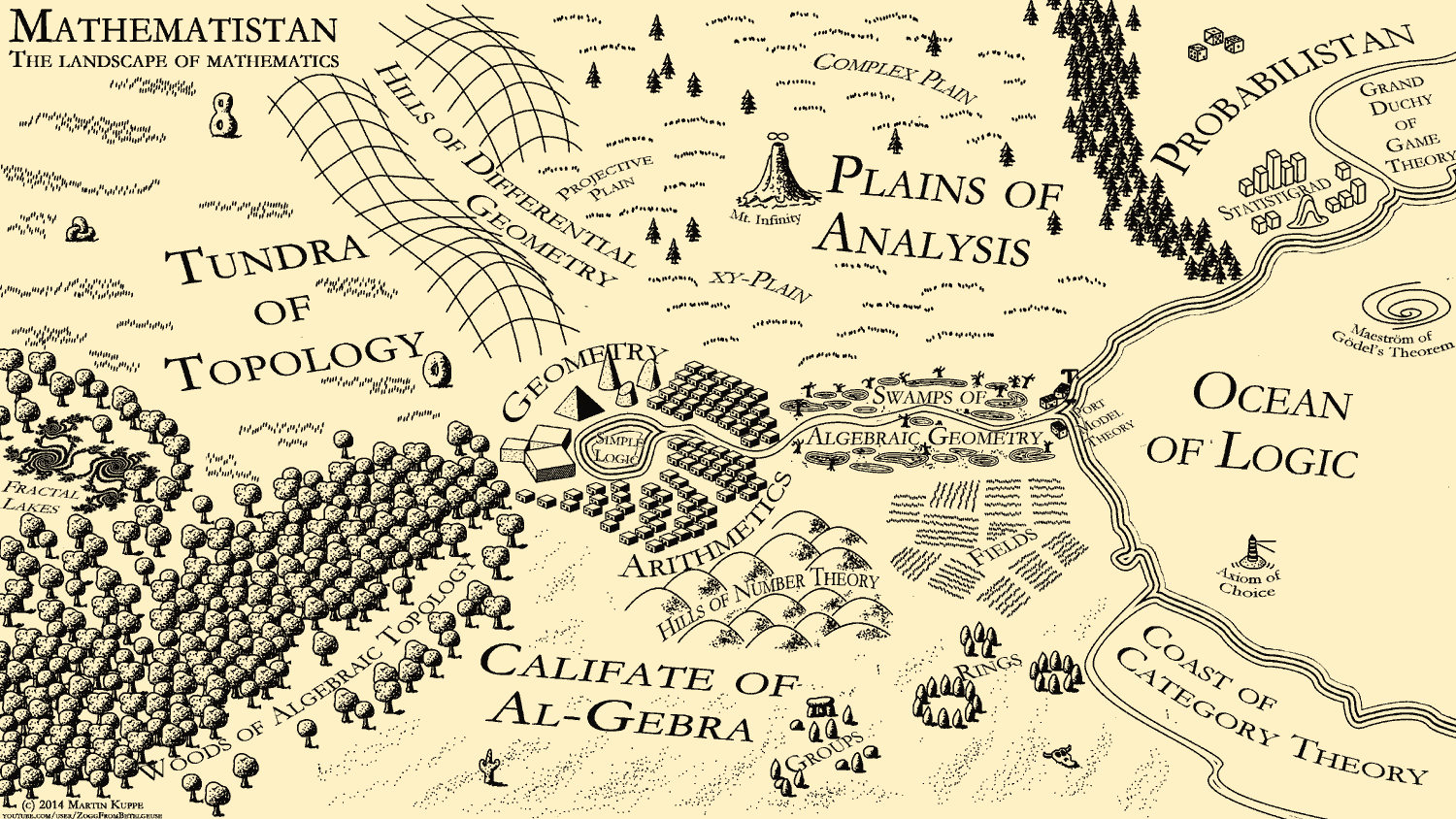
(and usually analysis is pretty far from logic in various people's maps of mathematics, but here's an exception, in which the "plains of analysis" [sic] are right next to the "ocean of logic": https://utenti.quipo.it/base5/scuola/mate_metafor_mathematis... )
(unfortunately going in the other direction, as with Yuri and Tonya Zhivago, I believe Vladimir Vysotsky might've done better —at least healthwise if not artistically— to have spent much more time in Paris with Marina)
Upon reflection, thanks for "♥ reflections"; I see the commentary there doesn't use the Star Wars Sith analogy I prefer, but instead talks (after Allison?) about a 修昔底德 trap.
Is there any english-language equivalent to this site? Did it grown organically out of the tradition of posting essays and counter-essays on village walls?
Could be! For some reason I was thinking of substack as more "subscribe to my newsletter" writing than "here's my bibliography" writing, but I could easily have prematurely stereotyped...
Btw.. I didn't want to look like I was the kind of person to put valproate [experimental protocols] in the same bin as psychedelics (which are tainted with profit and other motives)..
I just thought it would be a minor step forward if we could observe and manipulate our own learning processeses (as something close to sensations?)..
as opposed to being limited to observing what children or experts do.
Have psychedelics changed since my day? They used to be dirt cheap, which pretty much kept all the profit-chasers away. I guess th' freaks did have their own motives, tho


... so yeah, hw is more or less defined as something that cannot modify itself.